
Best non-toxic nonstick pans: what to buy instead of Teflon
The best nonstick cooking without PFAS comes from carbon steel, cast iron, and clean ceramic coatings. We ranked them on release, durability, and value, with sources.
By The PlasticFreeLab TeamUpdated June 30, 202612 min read
Disclosure·PlasticFreeLab tests and recommends independently. We sometimes earn a commission when you buy through our links. It never affects our rankings.
How the 89/100 was earned.
Made In Blue Carbon Steel Frying Pan
Carbon steel is the honest answer to the nonstick question, and the Made In is the cleanest example of it. It has no coating at all, so there is no PFAS, PFOA, or PTFE and nothing that can chip or wear through. Once it is seasoned it releases eggs and fish as well as a worn nonstick pan, it tolerates any heat and metal utensils, and it will outlast every coated pan in this list by decades. The only learning curve is seasoning it and keeping it dry, which is a few minutes of habit, not a chore.
Everything we'd buy, in order.
- 01Best overall91
Made In Blue Carbon Steel Frying Pan
Uncoated carbon steel that builds a natural, polymerized seasoning layer with use, giving real nonstick release with zero coating chemistry: no PFAS, PFOA, or PTFE, and nothing to scratch off into food. It is lighter and faster to heat than cast iron, takes any heat and metal utensils, and lasts for decades. The tradeoffs are honest: you season it before first use, dry it after washing, and avoid long-simmered acidic sauces that strip the seasoning. For everyday searing and eggs, it is the most durable non-toxic release pan you can buy.
SponsoredCheck Amazon - 02Best value88
Lodge Seasoned Carbon Steel Skillet
The same uncoated carbon-steel principle at the lowest price in the category, pre-seasoned at the factory so it is closer to usable out of the box. It is a touch heavier and rougher-finished than the Made In, which means the seasoning takes a little longer to become glassy, but the cooking surface is identical in kind. No coating, no PFAS, takes high heat and the oven. If you want to try carbon steel without committing premium money, this is the sensible entry point.
SponsoredCheck Amazon - 03Best heat retention85
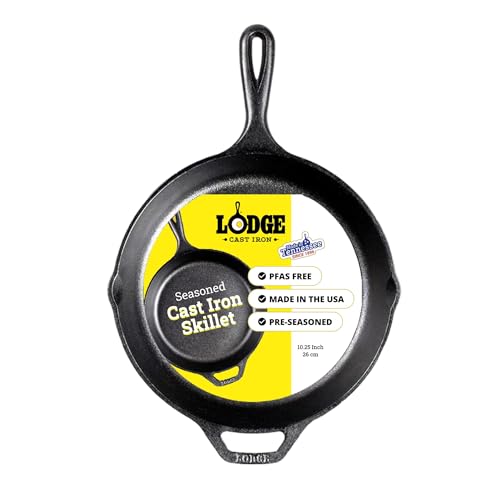
Lodge Cast Iron Skillet, 12-inch
Raw cast iron, pre-seasoned with vegetable oil and no synthetic coating, that becomes genuinely nonstick once well seasoned. It holds heat better than anything here, which is why it sears and bakes so well, and it is close to indestructible. It is heavy, slow to heat, and not ideal for delicate fish or acidic sauces, and it leaches a small, generally beneficial amount of dietary iron. For the price, nothing matches its longevity. Pair it with a carbon-steel pan for the lighter day-to-day cooking.
 SponsoredCheck Amazon
 - 04Best coated ceramic84
Caraway Ceramic-Coated Fry Pan
If you specifically want a sprayed-on nonstick surface, a sol-gel ceramic coating is the non-toxic version: free of PFAS, PFOA, and PTFE, and third-party tested for lead and cadmium below detection. It is the easiest pan here to use and clean, and genuinely non-toxic when new. The unavoidable caveat is lifespan: ceramic coatings degrade with normal use over roughly 12 to 24 months, after which you are cooking on the aluminium beneath. Treat it as a replaceable item, hand-wash it, and never use metal utensils. We break the formats down further in our best ceramic cookware guide.
SponsoredCheck Caraway - 05Best value coated82
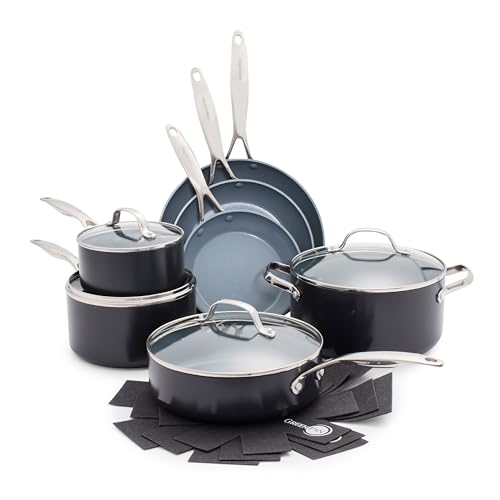
GreenPan Valencia Pro Ceramic Fry Pan
A Thermolon ceramic coating over a hard-anodized base, PFAS-free, at a lower price than Caraway with slightly better durability than thin-bodied coated pans. It earns its place as the budget coated option for people who want effortless release and accept that the coating is a multi-year consumable rather than a lifetime surface. Same care rules apply: medium heat, no metal utensils, hand-wash. A reasonable bridge pan while you get comfortable with carbon steel.
 SponsoredCheck Amazon
Named, not hinted at.
Traditional PTFE nonstick and steel-over-PTFE hybrids
We'd skip45This stands in for conventional Teflon-style nonstick and the hybrid pans that lay a stainless lattice over a PTFE layer. The coating is a fluoropolymer in the PFAS family, and while a modern, intact PTFE surface is stable at normal cooking temperatures, it can degrade and release fumes when overheated past about 500F, and it sheds as it scratches and ages. The hybrids are marketed as stainless but still contain PTFE, so they do not escape the issue. When the whole point is avoiding PFAS, an uncoated pan is the cleaner answer.
How this comparison was made
- What we picked for
- Disclosed materials, third-party certification, durability in real cooking, independent contamination testing where available.
- How we evaluated
- Manufacturer disclosures, regulatory filings, peer-reviewed papers, and hands-on wear-testing. We read the labels and the filings, not the press releases.
- Who disagrees with us
- We steel-man the opposing view in every comparison, and name the brand we almost picked and the reason we didn't.
- What would change our mind
- New independent lab testing, reformulation by a ranked brand, or a peer-reviewed finding that contradicts our current reasoning.
What people ask us most.
- What is the most non-toxic nonstick pan?
- Uncoated carbon steel and cast iron are the most defensible, because they achieve nonstick release through seasoning rather than a chemical coating, so there is no PFAS, PFOA, or PTFE and nothing that can chip into food. A well-seasoned carbon-steel pan releases eggs and fish nearly as well as a worn Teflon pan and lasts for decades. If you specifically want a sprayed nonstick surface, a sol-gel ceramic coating, like Caraway or GreenPan, is PFAS-free and non-toxic when new, with the caveat that the coating wears out in 12 to 24 months. The cleanest long-term answer is the seasoned pan; the easiest day-one answer is clean ceramic.
- Is traditional Teflon nonstick actually dangerous?
- The honest framing is nuanced. Modern PTFE (the Teflon coating) is made without PFOA, which was the compound DuPont paid to settle litigation over and which the US EPA flagged for health concerns, and an intact PTFE surface is chemically stable at normal cooking temperatures. The real issues are that PTFE can begin to break down and release fumes when a pan is overheated empty past roughly 500F (260C), and that as the coating scratches and ages it sheds particles into food. PTFE is also part of the broad PFAS family the EPA is now regulating in water. So it is not an emergency, but when the goal is avoiding PFAS entirely, an uncoated pan removes the question.
- Is carbon steel or cast iron better for nonstick cooking?
- They share the same coating-free principle but suit different jobs. Carbon steel is lighter, heats and cools faster, and has a smoother surface, so it is the better everyday pan for eggs, vegetables, and quick searing. Cast iron is heavier and holds heat far longer, which makes it superior for a hard sear, cornbread, or anything that goes from stovetop to oven. Both build a natural nonstick seasoning, both last for decades, and neither has any coating to fail. Many non-toxic kitchens keep one of each. If you can only buy one and want a daily driver, start with carbon steel.
- Do ceramic nonstick pans really avoid PFAS?
- Yes, genuine sol-gel ceramic coatings such as Thermolon and the finishes used by Caraway and Our Place are silica-based and free of PFAS, PFOA, and PTFE, which is their real advantage over traditional nonstick. The catch is durability, not chemistry: ceramic coatings lose their release performance faster than PTFE, typically within 12 to 24 months of normal use, after which you are cooking on the metal beneath. Watch out for hybrid pans that combine a steel surface with an underlying PTFE layer, which are marketed alongside ceramic but are not the same thing. Read the construction, not just the word ceramic.
- How do I season a carbon steel pan so it is actually nonstick?
- It is simpler than it sounds. Wash off the factory beeswax coating, dry the pan, then heat it with a very thin film of a high-smoke-point oil (grapeseed or flaxseed work well) until it just starts to smoke, let it cool, and repeat two or three times. The oil polymerizes into a hard, slick layer bonded to the steel. After that, cook fatty foods early on, avoid long acidic simmers that strip the layer, wash with minimal soap and a soft brush, and dry it on the stove so it never rusts. The surface improves with every use, which is the opposite of a coated pan.
New independent lab testing that contradicts our current ranking. A reformulation by a top pick that quietly drops a disclosed certification. A peer-reviewed paper that changes the safety picture on one of the materials above. We'll update this page within a week and mark what changed.
Sources we cited on this page.
The PlasticFreeLab Team
A small group of researchers and writers cutting through the noise around non-toxic living. We read the studies, read the labels, test the products. We update our recommendations as the science evolves. We do not accept payment for product placement, we disclose every affiliate relationship, and we name the brands we reject.
Related in this hub.
- The Explainer8 min
Do Plastic Cutting Boards Shed Microplastics? The Study Explained
Kitchen · A 2024 study found that chopping on plastic boards can release microplastics into food. Here are the numbers, their limits, and the simple, sensible takeaway.
- The Explainer7 min
Is Caraway Cookware Non-Toxic? An Honest Verdict
Kitchen · Caraway uses a ceramic non-stick coating free of PFAS, PFOA, lead, and cadmium. Here is what that means, where the limits are, and who it is worth it for.
- The Explainer7 min
Is Our Place Cookware Non-Toxic? An Honest Verdict
Kitchen · The Our Place Always Pan uses a ceramic non-stick coating free of PFAS, PFOA, lead, and cadmium. Here is what that means and where the limits are.
- The Comparison13 min
Best Non-Toxic Rice Cookers of 2026, Tested and Ranked
Kitchen · We ranked 7 rice cookers on the one thing that decides non-toxic, the inner pot, favoring bare 18/8 stainless steel and unglazed clay over PTFE nonstick, with FDA, EPA, and NSF sources and one coated cooker we'd skip.
Get the Kitchen Swap Audit.
A printable checklist of 50+ kitchen items, each ranked swap now / swap eventually / don't bother. Free. Delivered instantly.
By subscribing, you agree to our Privacy Policy. One calm email a week. Unsubscribe anytime.
50+ items